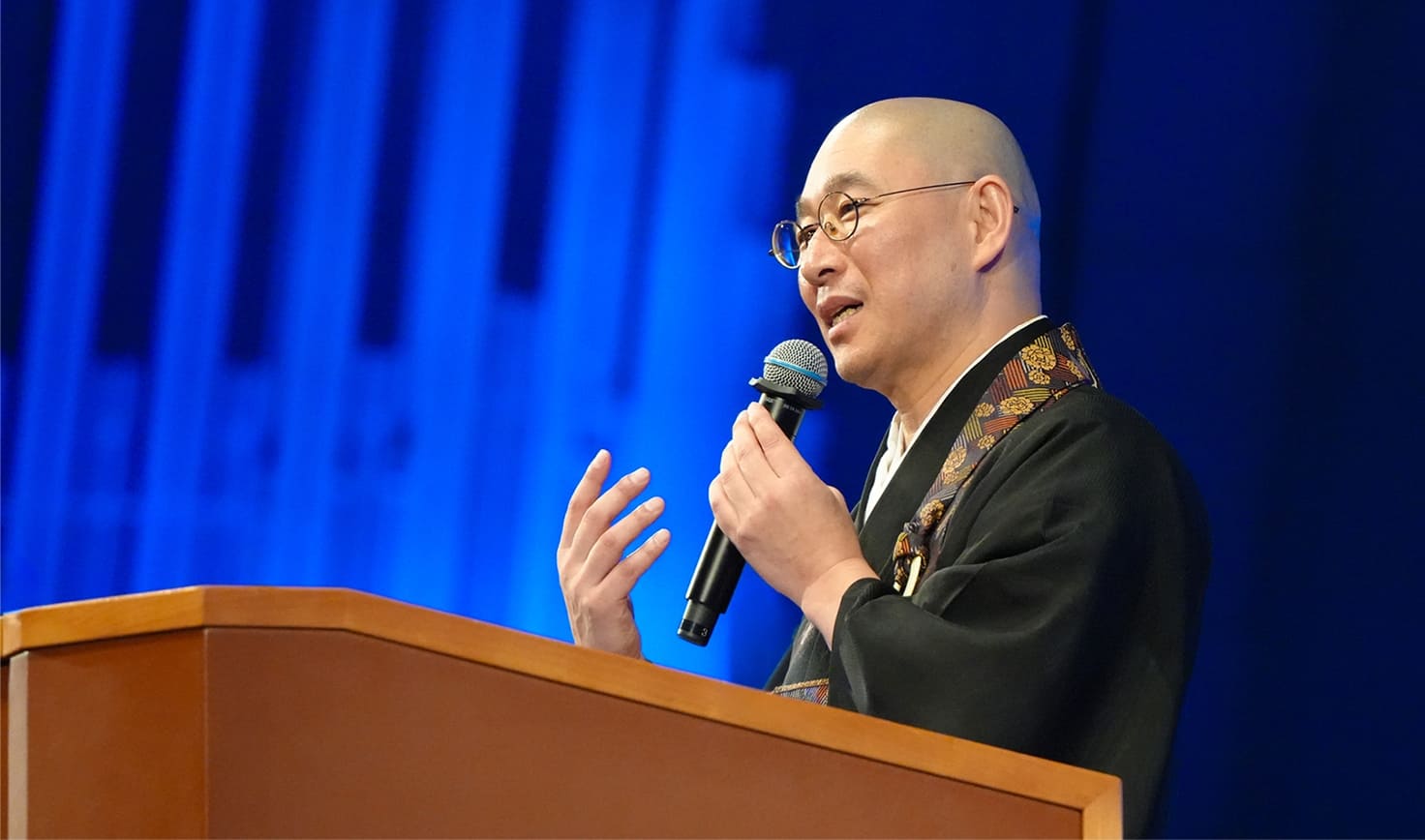


Message from Osho Taigu
-

- Message from Osho Taigu
Leaders, Especially
in the Age of AI,
Learn What It Means
to Be Human
The further technology advances, the more our aspirations matter.
AI is becoming more intelligent at a staggering pace.
It writes text.
It creates pictures.
It analyzes markets.
It develops strategies.
It even comes up with new businesses.
Knowledge that once took people years to acquire is becoming available to everyone.
Robots are evolving.
There are fewer people.
Markets are changing.
What brought success yesterday may no longer work tomorrow.
As a business leader, you probably feel some fear alongside your anticipation.
But I believe we are fearing the wrong thing.
We should not fear AI becoming more intelligent than human beings.
We should fear losing sight of what we are using it for, even as we gain access to its immense technological power.
We Already Have Enough Answers
AI will give us answers in abundance.
How should we sell?
How should we attract customers?
How should we improve efficiency?
What products should we create?
But these are the questions I want to ask business leaders:
Why do you run your company?
Whose suffering do you want to ease?
Whom do you want to bring joy to?
What will you protect?
What are you willing to let go of?
Beyond making a profit, what do you want to leave behind?
And what do you want to leave within this company after you are gone?
AI can provide answers.
But human beings must decide which questions to ask.
Precisely because we live in an age overflowing with answers, business leaders need deeper questions.
Do Not Try to Predict the Future. Establish Your Guiding Principles.
We do not know what the future holds.
How far will AI advance?
Which jobs will disappear?
What new industries will emerge?
No one knows.
So do not let yourself become consumed by trying to predict the future.
What you need is not the ability to foresee it.
You need guiding principles that keep you from losing your way, even when your predictions prove wrong.
For more than 2,500 years, Buddhism has closely observed human beings.
Nations have changed.
Rulers have changed.
Wars have broken out.
Epidemics have spread.
Civilizations have changed.
Yet the fundamentals of human nature have remained much the same.
We desire.
We become angry.
We lose our way.
We love.
We are hurt.
We grow old.
We fall ill.
And we die.
That is why, the more turbulent the times become, the more deeply we must look into what it means to be human.
The same is true of business.
Only Those Who Hold Firm to What Must Not Change Can Change Boldly
I am not telling you to preserve what is old.
Quite the opposite.
Change what needs to change, without hesitation.
Change your products.
Change your businesses.
Change your organization.
Change how you sell.
Use AI.
Use robots.
But why do you run your company?
If you change even that to follow the latest trends, your company will drift.
In Busshin Keiei Mandala, we call this central commitment a “vow.”
What do you want to bring into being?
For whom do you work?
What kind of society do you want to pass on to the next generation?
Once this aspiration is firmly established, change is no longer something to fear.
Because you have something that must not change, you can boldly change what should.
This is the backbone of business leadership.
Compassion × Buddha-Nature × Technology = Business
Where, then, do new businesses come from?
This is how I see it:
Compassion × Buddha-Nature × Technology = Business
Technology does not come first.
Compassion does.
Look closely at people.
At your employees.
Your customers.
Your business partners.
Your family.
Society.
What are they suffering from?
What makes their lives difficult?
What have they given up on?
What would bring them greater joy?
There lie the seeds of a business.
Next, look at Buddha-nature.
What are we capable of?
What strengths do our employees possess?
What untapped technical skills, experience, trust, and practical capabilities lie within our company?
Before chasing someone else’s success, dig into the ground beneath your own feet.
Only then should you turn to technology.
Use AI.
Use robots.
Make full use of new technologies.
But do not let technology become the master.
Human beings should not serve technology.
Make technology serve people.
The question is not, “What can AI do?”
It is, “What will we have AI do for people?”
That is the work of a business leader.
Entrust AI with How We Do Things. Cultivate Who We Are.
Business leadership has two dimensions:
How we do things.
And who we are.
How do we sell?
How do we attract customers?
How do we analyze?
How do we improve efficiency?
These are questions of how we do things.
AI will help us with these tasks at a remarkable and accelerating pace.
So entrust it with what can be entrusted to it.
For our part, we must cultivate who we are.
What do we aspire to?
What do we hold dear?
Whom will we walk alongside?
What must we never do?
How will we use our profits?
What kind of people will we be as we lead our businesses?
The more intelligent AI becomes, the more the depth of a business leader’s humanity will matter.
That is what I believe.
Before You Turn to Technology, Establish Your Aspiration
Busshin Keiei Mandala has nine mirrors:
SEIGAN(誓願)
JIGYO(事業)
KAIRITSU(戒律)
KANKYO(環境)
ZENYU(善友)
KOSEN(広宣)
SHIN-EN(親縁)
TOMYO(灯明)
FUSAN(富産)
Yet at their center is one thing:
SEIGAN—our vow.
Why do we live?
Why do we work?
Why do we run a company?
Make that vow.
Then look closely at people’s suffering.
Cultivate your own Buddha-nature.
Use technology wisely and for good.
Join forces with others.
Build trust, one act at a time.
Create wealth and pass it on to the next generation.
That is Busshin Keiei Mandala.
I am not pessimistic about the future of AI.
Nor am I optimistic.
Technology itself is neither good nor evil.
What matters is the human being who uses it.
That is why business leaders today need to do more than keep pursuing the latest technology.
They need to go deeper, down to their roots, and ask:
What do I truly aspire to?
Then they must firmly establish that aspiration.
The further technology advances, the more our aspirations matter.
The more answers abound, the deeper our questions must become.
The more turbulent the changes, the stronger our guiding principles must be.
The further technology advances, the more we must cultivate our humanity.
Before you turn to technology, establish your aspiration.
Busshin Keiei Mandala is not a management theory for predicting the future.
It is a compass for business leadership, enabling leaders to stand on their own feet, whatever the future may bring.
Taigu Gensho
Representative Director
Keiei Mandala General Incorporated Association